
The Student Stress Guide: Balancing Heavy Coursework and Mental Wellbeing in 2026
For the contemporary UK university student, the “dream” of higher education is increasingly shadowed by a culture of high-stakes performance and financial instability. As of early 2026, data from the Office for Students (OfS) suggests that student mental health remains a top-tier national priority, with over 37% of undergraduates reporting symptoms of clinical anxiety or depression—a figure significantly higher than the general UK population of the same age.
Whether you are navigating the historic halls of Russell Group institutions or the modern campuses of post-1992 universities, the pressure of “heavy coursework” is a shared burden. This guide provides a strategic framework for managing your degree without compromising your psychological health.
The UK Academic Landscape: Why 2026 is Different
The shift in 2026 is the convergence of two major pressures: the digital-first learning model and the post-inflationary economic squeeze. Unlike previous generations, today’s UK students are often “commuting students” or working 20+ hours a week to fund their degrees, leaving very little “cognitive surplus” for complex essay writing and research.
When the workload exceeds your capacity, it is a sign of intelligence to look for support. For many, seeking professional assignment help is no longer a luxury but a necessary time-management tool. Delegating a literature review or a data-set analysis can provide the 15–20 hours of “recovery time” needed to prevent a full-blown academic burnout.
See also: Unblocked Game 66EZ How to Play Unblocked Games
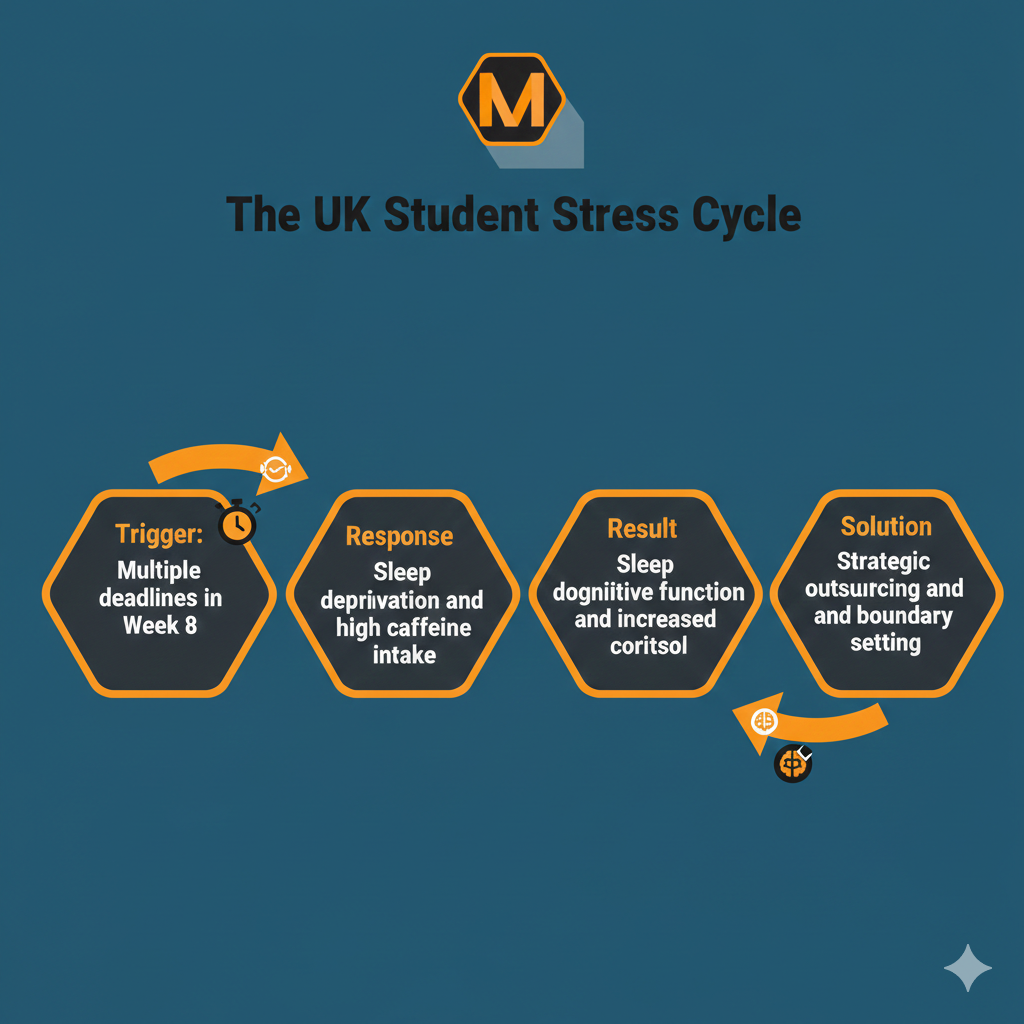
The UK Student Stress Cycle
Navigating the “Assessment Load”
In the UK, many modules are now heavily weighted toward single, high-stakes summative assessments. This “all-or-nothing” approach is a primary driver of student distress.
- The Triage Method: Treat your modules like an A&E doctor. Identify which assignments require “Urgent” attention and which are “Stable.”
- The Power of Extensions: Most UK universities now have simplified “Self-Certification” processes for 7-day extensions. Use these before you reach a crisis point.
- The “Buy-Back” Strategy: If you find yourself choosing between a part-time shift that pays your rent and a 3,000-word report, some students choose to buy assignment online to maintain their academic trajectory without falling into debt. In a 2026 economy, balancing your financial and academic ledgers is a survival skill.
Data-Driven Wellness: What the UK Stats Say
Recent studies from Student Minds and the Mental Health Foundation highlight a worrying trend:
| Key Statistic (2025/26) | Percentage | Source |
| Students overwhelmed by exam pressure | 85% | Education Today |
| Students working 15+ hours/week | 58% | HEPI Survey |
| Reported “burnout” symptoms | 1 in 4 | NHS Digital |
| Students using AI for drafting help | 21% | GoStudent Report |
The 3 Pillars of British Student Resilience
A. Radical Time Blocking
Stop “multitasking.” The brain takes 23 minutes to refocus after checking a notification. Use the Pomodoro Technique (25 mins work / 5 mins break) to create deep-focus sessions. In the UK, libraries like the British Library or university “Quiet Zones” are designed for this—use them.
B. The NHS “Five Ways to Wellbeing” Adapted
- Connect: Join a university society (non-academic).
- Be Active: A 20-minute walk through a local park (like Hyde Park or the Peak District).
- Take Notice: Use mindfulness apps like Headspace (often free for students).
- Keep Learning: Learn a skill unrelated to your degree (e.g., cooking or a language).
- Give: Volunteer for a few hours; it shifts focus from your own stress to others’ needs.
C. Leveraging Institutional Support
Every UK university has a Wellbeing Hub. From “Mental Health First Aiders” to “Disabled Students’ Allowance (DSA)” for those with ADHD or anxiety, these resources are funded by your tuition fees. Use them.
Final Thoughts: The Degree is a Tool, Not a Life
In the UK, we often talk about “stiff upper lips,” but in 2026, the most successful students are the most vocal about their needs. Academic excellence is a marathon. If you need to slow down, ask for help, or outsource a task to stay healthy, you aren’t failing—you’re managing.
FAQs: Your Concerns Answered
Q: Will using academic support affect my degree classification?
A: Not if used as a model or a study aid. Professional guidance helps you understand how to write at a First-Class level, which actually improves your long-term academic skills.
Q: I can’t afford a therapist; where do I go?
A: Use the NHS “Talking Therapies” service or the Student Space platform. Most universities offer 6 free counselling sessions per year.
Q: Is it “normal” to cry over my dissertation?
A: While common (58% of UK students admit to it), it shouldn’t be the norm. If you are crying regularly, it’s time to trigger an “extenuating circumstances” claim.
References
Office for Students (2026): National Student Survey Trends.
NHS Digital: Mental Health of Children and Young People in England, 2025.
HEPI: 2025 Student Academic Experience Survey.
Save My Exams: UK Exam Stress Statistics 2024–2026.
Author Bio
Dr. Alistair Thorne is a Senior Education Consultant and former lecturer at the University of Manchester. With a PhD in Educational Psychology, Alistair has spent two decades researching student retention and mental health outcomes across the UK. He currently advises HE institutions on “Wellbeing-First” curriculum design and is a regular contributor to The Times Higher Education.